

A post-mortem on autopilot dressing
What 175 women reveal about ease and pleasure (Part 2 of 4)

For so many women, getting dressed has stopped being a problem.
Fewer decisions.
Less second-guessing.
More things that just work.
On paper, that looks like progress.
And yet — something else slipped out the side door at the same time. Not stress, but engagement. Not chaos, but curiosity.
This isn’t a story about trends, confidence, or women losing interest in style. It’s about how ease becomes a solution — and how solutions quietly come with side effects.
Once you see the mechanism underneath, it’s hard to look at “easy” the same way again.
this piece assumes you’ve devoured part 1. if you haven’t yet indulged…

Getting dressed feels easy — but that’s not the same as feeling good
If you only look at the numbers, getting dressed doesn’t look like a problem at all. Most women place it right in the middle — even leaning low — on the stress spectrum.
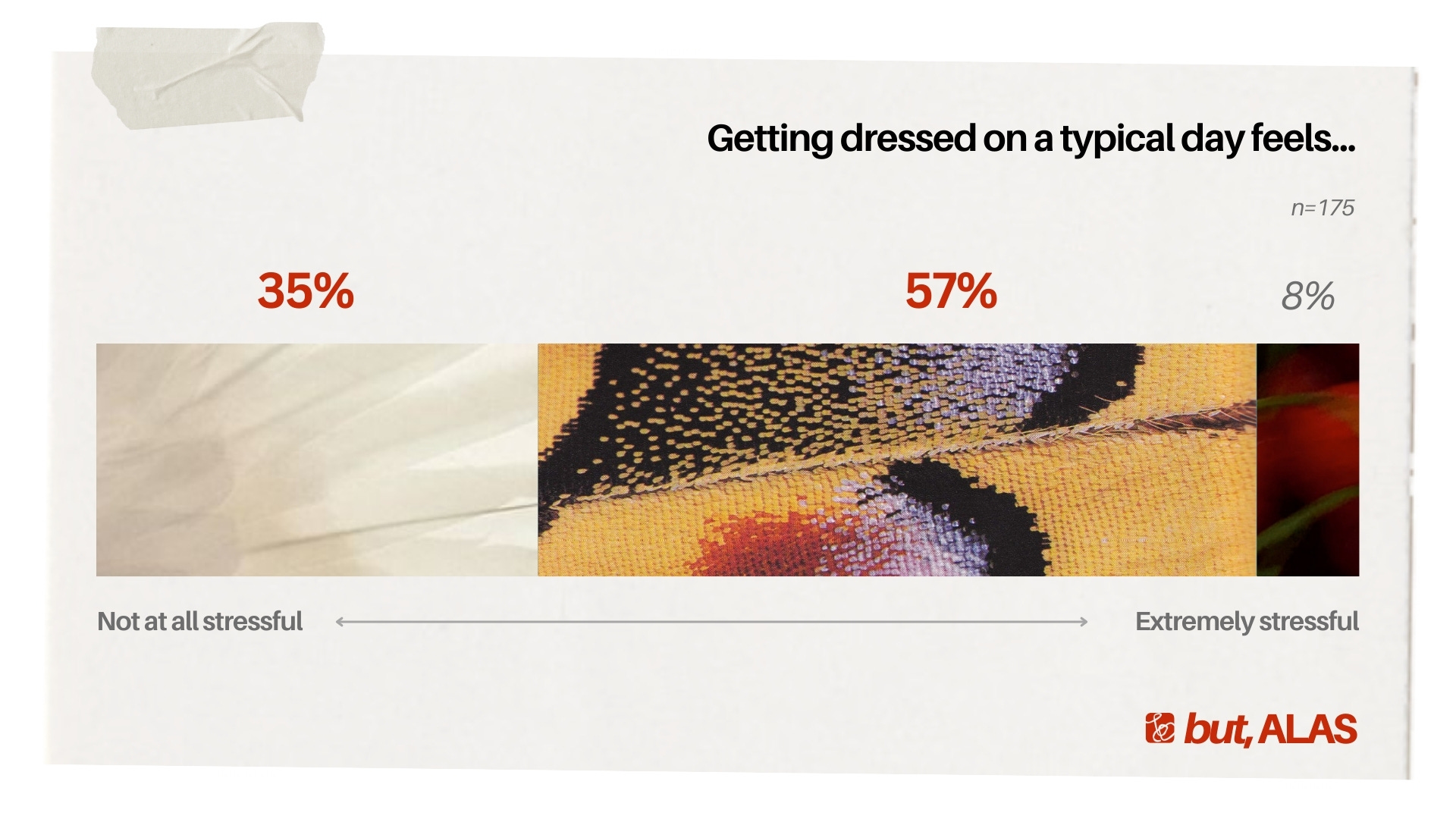
If you stopped there, you might conclude that things are… fine. But the story doesn’t live in the scale. It lives in the subtext!1
When you read the corresponding open-ended responses, almost no one sounds engaged.
There’s very little anticipation.
Very little pleasure.
Almost no curiosity.
What shows up instead — relentlessly — is efficiency.
“I already know what I’m going to wear.”
“I wear the same thing most days.”
“I just throw something on.”
“I pick it the night before.”
“I wear scrubs / a uniform / yoga pants.”
“I don’t really care anymore.”
This isn’t ease-as-enjoyment. It’s ease-as-decision-elimination.2
Low stress here doesn’t mean people feel good about what they’re wearing.
It means they’ve found a way to stop engaging with the question at all.
That distinction matters.
The contradiction hiding in plain sight
Read enough responses side by side and a strange pairing keeps repeating:
“I wear the same thing every day.”
“It’s comfortable but not attractive.”
“I don’t like what I see in the mirror.”
“I hate trying to find something to wear.”
Ease and dissatisfaction — holding hands.
Again.
And again.
And again.
That’s because ease has quietly replaced pleasure — not as a preference, but as a coping strategy.
No one is saying, I feel expressed.
They’re saying, I removed a decision.
Which explains why getting dressed can register as low-stress while still feeling flat.
Ease solved friction.
It didn’t solve desire.
And I fear many of us are confusing the two.
What it feels like when an outfit actually works
This is where the language shifts.
When people talk about the rare days an outfit actually lands, efficiency disappears from the vocabulary entirely.
No one says they were more productive.
Or optimized.
Or “on.”
They lean into identity:
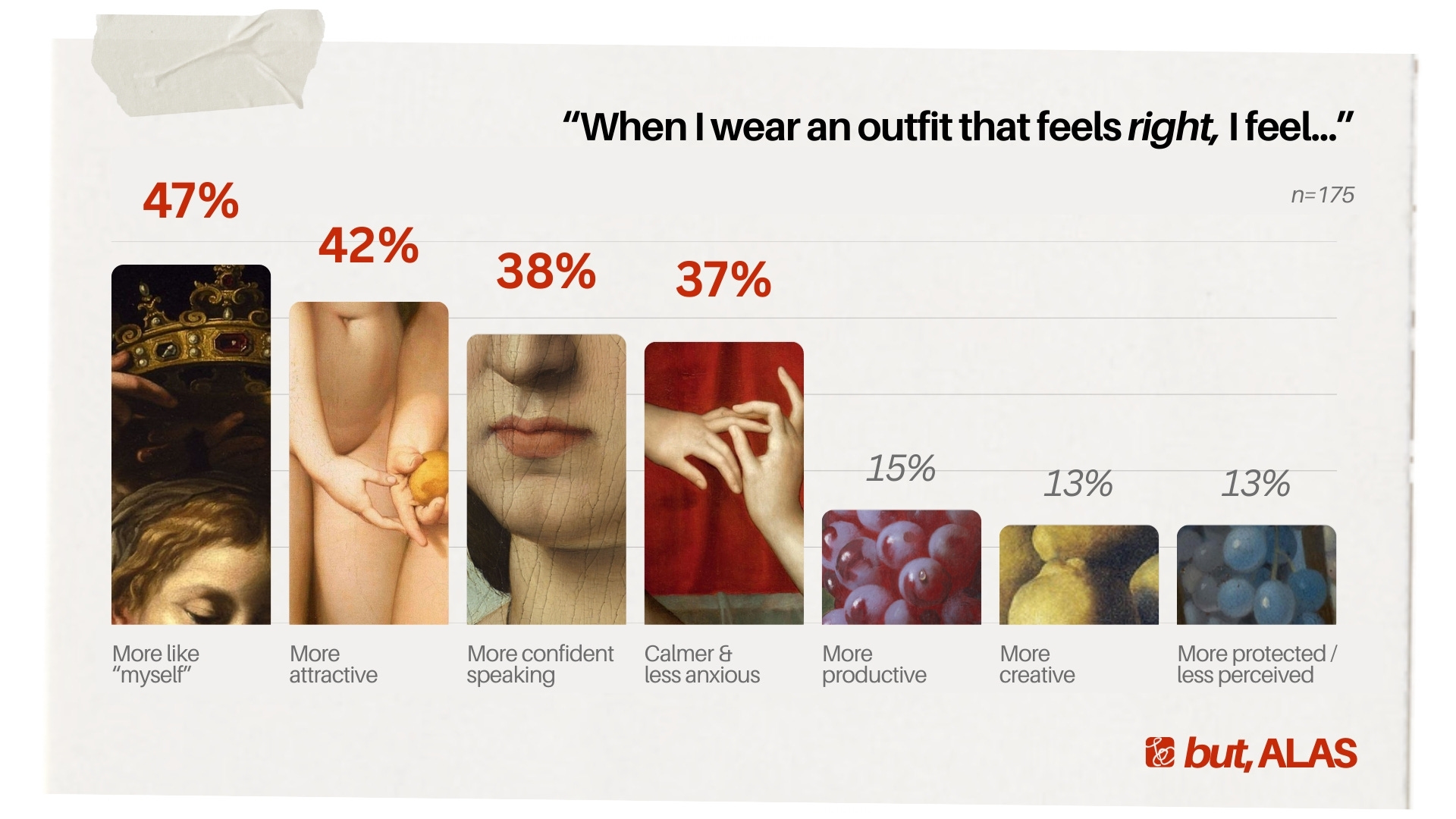
“I feel more like myself.”
“I feel attractive.”
“I feel more confident taking up space.”
“I feel calmer. Less anxious.”
That’s telling.
When clothing works, it’s not helping people do more.
It’s helping them stop managing themselves.
The reward isn’t transformation.
It’s relief.
Which, honestly, says a lot about the baseline we’re all operating from.
[zooming out from the closet]
The stress didn’t disappear — it relocated
Now the mechanism comes into focus.
When women talk about stress around getting dressed, it almost never actually lives in the closet.
It lives around it.
Waking up.
Motivation.
Depression.
Body image.
Exhaustion.
Caregiving.
Work pressure.
Money.
Weather.
Laundry (always laundry).
One woman cut through the entire dataset with two sentences:
“Girl, deciding what to wear is easy. Getting out of bed is what’s hard.”
She wasn’t minimizing the question. She was locating the weight.
Clothing has been demoted to a functional layer inside a much heavier system. It’s no longer asked to carry meaning — only to not make things worse.
That’s why outfits get described as “fine,” “easy,” or “whatever.”
They aren’t meant to give.
Only to not take.
Regulation > Expression
Once you read the data through this lens, the pattern snaps into focus.
Most women aren’t dressing to express themselves.
They’re dressing to stay regulated.
[what women actually say they’re optimizing for]
“calm”
”control”
”settling”
”managing anxiety”
”getting through the morning”
”not spiraling”
”not thinking too much”
In other words, clothing isn’t being used as a creative medium. It’s being used as a nervous-system tool. And this isn’t anecdotal — it’s structural. In the quantitative data, two findings stand out:
29% say they dress to look composed even when they don’t feel it
19% of respondents say they dress primarily to regulate themselves
Together, nearly half of the sample3 is using clothing to manage internal state — not to explore identity or express desire.
That’s not a styling preference. That’s an adaptation.
Ease isn’t about liking the outcome.
It’s about minimizing activation.
When your baseline includes anxiety, fatigue, pressure, or overwhelm, the job of clothing quietly changes:
Not → Who do I want to be today?
But → How do I keep myself steady enough to start?
Expression doesn’t disappear because it isn’t valued.
It disappears because regulation comes first.
The mechanism: autopilot dressing
This is what the data keeps circling.
Not minimalism.
Not laziness.
Not confidence.
Autopilot dressing.
You can spot it by its markers:
repeated outfits
default silhouettes
uniforms (formal or informal)
night-before planning
avoidance of accessories
hair or makeup as the only “controlled” variable
strong reliance on temperature-based logic (“I just dress for the weather”)
Autopilot dressing stabilizes the system. And stability is seductive.
But autopilot doesn’t show up because the terrain is easy.
It shows up because constant correction is exhausting.
You see the same logic in the obsession with matching sets — not as fashion, but as cognitive mercy.
“One decision instead of five.
A full thought instead of a fragment.”— Isle of Monday, Girls LOVE a matching set
That isn’t a style statement.
That’s bandwidth preservation.
[what gets traded for stability]
Clothing as a tool — not a place to explore
Here’s the paradox the data resolves cleanly. People are actually extremely fluent in using clothing as a tool:
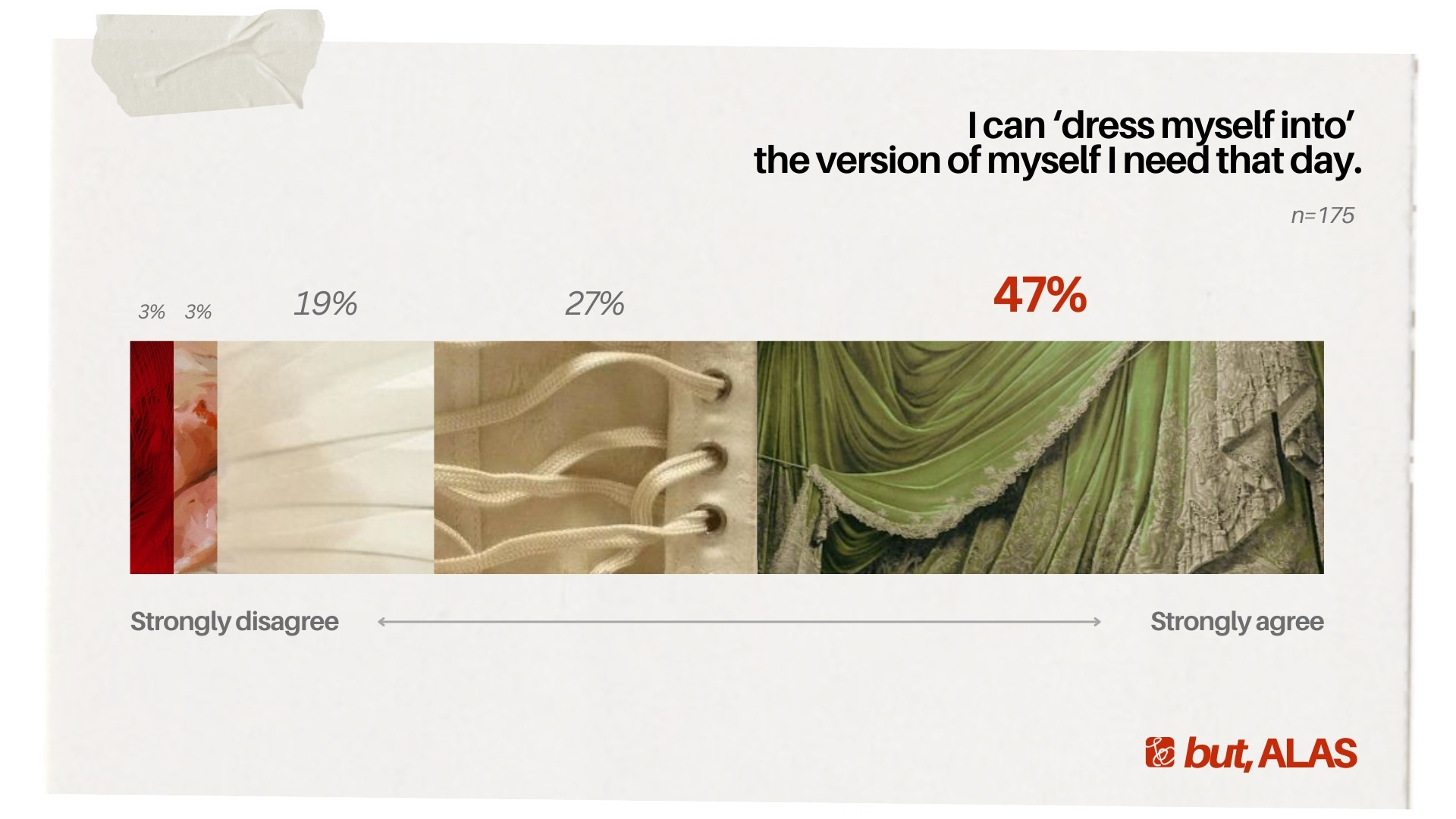
They know it can shift their mood.
They know how to deploy it when needed.
They know how to make it calm them, protect them, legitimize them.
What they’ve stopped asking clothing to do is surprise them. Not because they don’t care — but because surprise requires surplus. And most people are living without margin.
What’s been stabilized is the system. What’s gone missing is curiosity.
Why this matters before we move on
Women are not overwhelmed by getting dressed.
They’re under-engaged with it.
Fashion has quietly shifted from a site of aspiration to a site of risk management. And low stress isn’t a win here — it’s a signal.
A signal that the system has been stabilized by making it smaller.
If I had to name the condition, I’d call it:
Functional peace.
Aesthetic numbness.
Stability without pleasure.
Effortlessness without aliveness.
Confidence without curiosity.
People aren’t fighting the closet anymore. They’ve solved it. And solving it means asking less of it.
Up next:
What our clothes are quietly protecting us from & what gets lost in the process.
the subtext is where i, too, have taken up permanent residence ;)
(which sounds healthy until you realize how often it shows up alongside dissatisfaction — and how rarely it shows up next to joy)
which statement feels true most of the time?
34% — I dress based on the role I’m stepping into
29% — I dress to look composed even when I don’t feel it
19% — I dress to regulate myself (calm, ground, settle)
13% — I dress mostly out of habit
4% — None of these quite fit
This is so true.
Also, always. laundry.
Love it