

This is not a fashion dataset
I spent $300 to ask women how getting dressed feels (Part 1 of 4)

[a small, slightly unhinged preface]
Hi — my name is Sarah!
I spent about half a decade in market research before becoming a tech executive, which means two things are true at once:
I know how priceless good data is.
I am still ruthless about hunting down the answer to a question simply because it won’t leave me alone.
Over Christmas break — in that strange liminal week where time doesn’t exist and your frontal lobe intensely comes back online — I realized I was thinking about clothes a lot.
Not trends.
Not shopping.
Just the feeling of getting dressed.
It had started to feel heavy. Flat. Oddly neutral — but not in a way that felt like peace.
So, in a small act of financial recklessness1 disguised as intellectual curiosity, I spent +$300 of my own money to run a survey on how women are actually getting dressed right now.
No brand agenda.
No product.
No funnel.
Just curiosity. And questions. And a hunch.
This is the first of a four-part series unpacking what came back.
And I need to tell you this up front: What I got is not a fashion dataset.
The results that look fine (at first)
If you skim the topline results — the kind you’d see in a deck or a headline — everything looks… fine. Reasonable, even.
When asked what getting dressed is optimized for right now, women most often selected comfort, efficiency, and confidence.
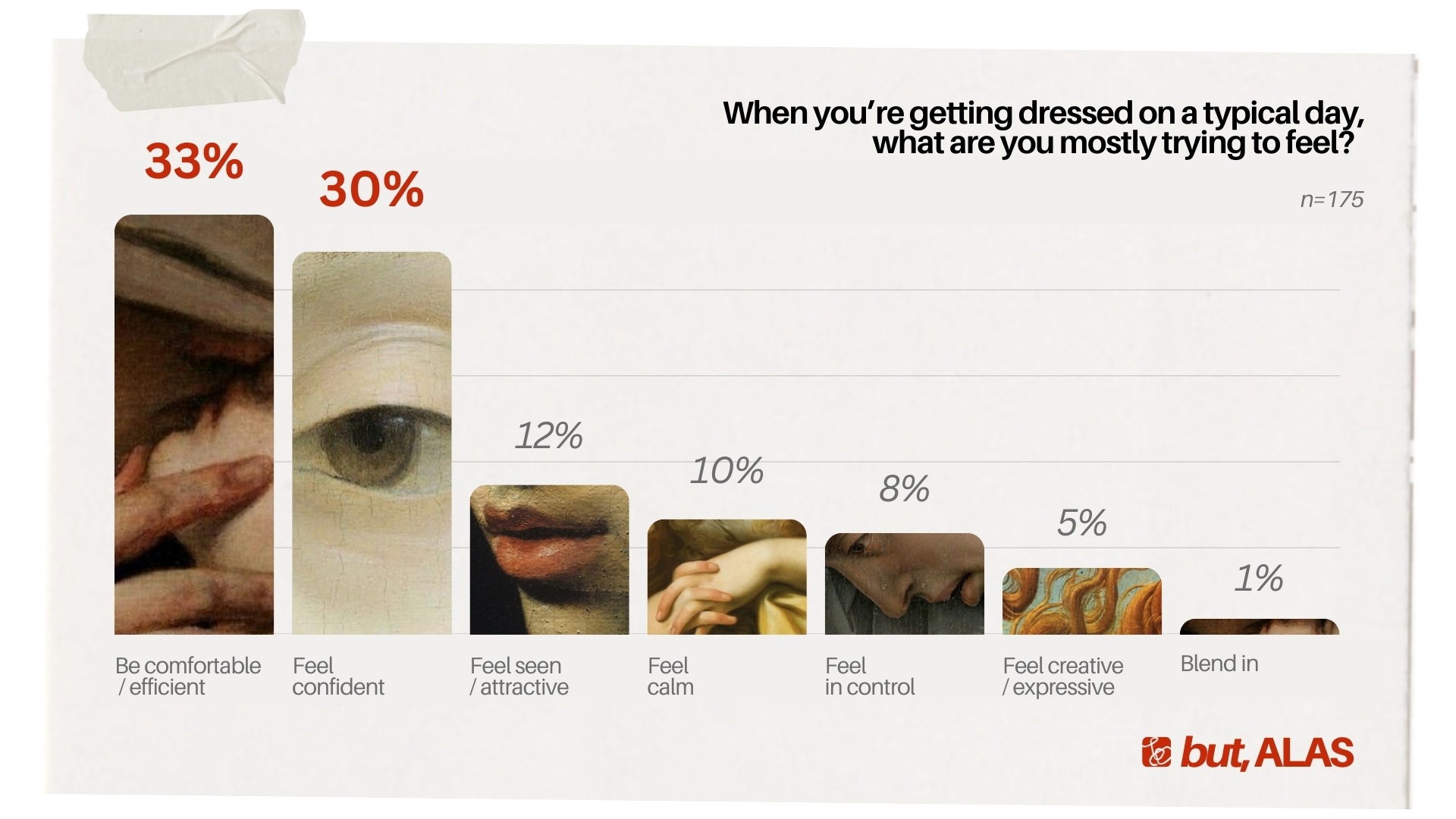
If this were a meeting, this is where everyone would nod.
Comfort.
Confidence.
Context.
It reads as adulthood. Balance. Having your priorities straight.
On paper, this is the kind of data you move past quickly — satisfied that nothing is wrong.
But the story doesn’t live in the percentages.
It lives in the sentences people wrote when no one was forcing them to choose from a list.
So let’s slow down, and dig into the narrative under the surface. Lord knows we’re not in the business of flattening 175 women into a bar chart.
wait! before the thesis lands: what has getting dressed felt like for you lately?
Comfort is not about fabric.
Once you get into the open-ended responses, something shifts.
The word comfort shows up constantly — but almost never in the way fashion language usually means it.
People didn’t talk about softness.
Or stretch.
Or cozy silhouettes.
They talked about time.
“I don’t have a lot of time to get ready.”
“I’m always on the go.”
“I work long days.”
“I just need to function.”
They talked about mental load.
“I have anxiety.”
“I get overstimulated.”
“I don’t want to think too much.”
“I’m already overwhelmed.”
They talked about containment.
“I don’t want attention.”
“I want to blend in.”
“I don’t want to stand out.”
Comfort, here, isn’t indulgence.
It’s capacity preservation.
It’s dressing in a way that doesn’t require follow-up questions — from other people or from yourself. Outfits that don’t need monitoring. Outfits that don’t turn your body into a conversation you have to host all day.
When someone says, “I just want to be comfortable,” what they’re really saying is: I cannot afford more friction in my life right now.
Confidence, in this data, is actually quiet.
At first glance, that sounds familiar. Encouraging, even.
But once you read what people actually mean by confidence, the word starts to shrink.
This isn’t confidence as boldness.
Or visibility.
Or reinvention.
It’s confidence as nothing going wrong.
People described feeling confident when:
nothing felt “off”
they didn’t have to keep checking themselves
they felt presentable enough to move through the day
There’s very little language here about standing out. There’s a lot of language about simply holding it together.
Confidence as legitimacy
What’s striking is how rarely confidence is described as expressive or aspirational either.
Instead, it sounds like:
“Knowing I’m capable.”
“Feeling in control.”
“Being able to handle my responsibilities.”
“Feeling presentable.”
“Not falling apart.”
This is confidence as permission.
Permission to take up space without apology.
Permission to be taken seriously.
Permission to exist in public without constant self-correction.
Not: Do I feel interesting?
But: Do I look acceptable enough to proceed?
Dressing downstream of life pressure
Once you sit with the responses long enough, something becomes clear: People aren’t dressing from preference. They’re dressing downstream of pressure.
The outfits in this dataset don’t start in the closet.
They start in the conditions of the day.
Caregiving.
Work.
Money.
Anxiety.
Bodies that have changed.
Energy that doesn’t replenish the way it used to.
Clothes aren’t supporting identity first.
They’re supporting labor.
Regulation.
Continuity.
When life is structured around responsibility, clothes stop being expressive objects and start behaving more like equipment.
That doesn’t mean people don’t care. It means they’re prioritizing what lets them get through the day intact.
Utility doesn’t “trend.” It accumulates.
When you look at Google search behavior over time, a pattern emerges that mirrors the emotional logic of the survey almost too cleanly to ignore.
Terms like:
quiet luxury
athleisure
capsule wardrobe
don’t spike and vanish.
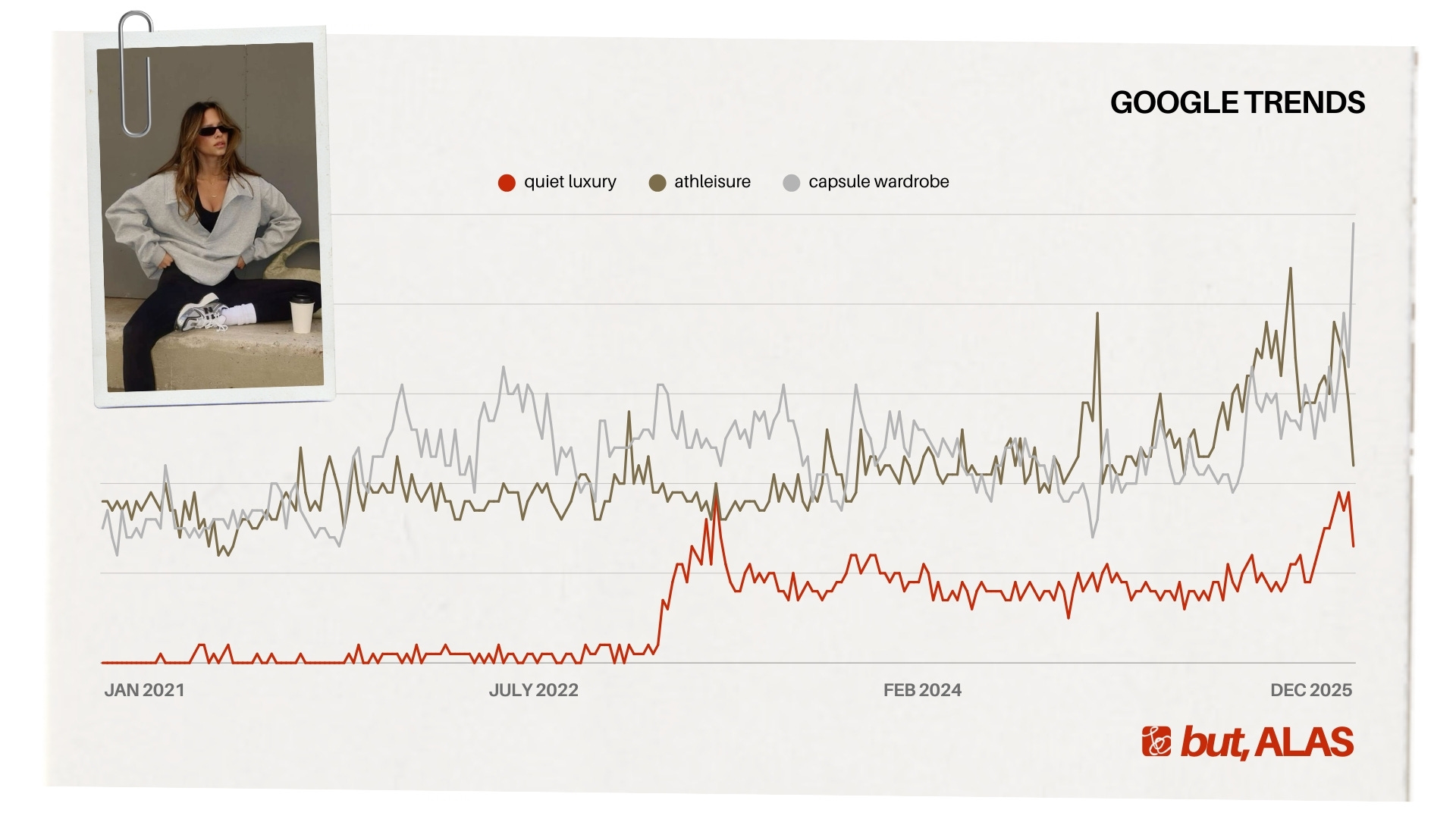
They rise slowly.
They hold.
They compound.
These aren’t aesthetics people try on. They’re systems people settle into. Not because they’re boring — but because they reduce decision load.
They promise:
fewer choices
fewer mistakes
fewer mornings that feel like negotiations
In other words: lower cognitive cost.
That’s not a trend. That’s infrastructure.
Performative aesthetics burn hot — then fizzle
Now compare that to aesthetics built around being seen:
mob wife aesthetic
coastal grandma
office siren
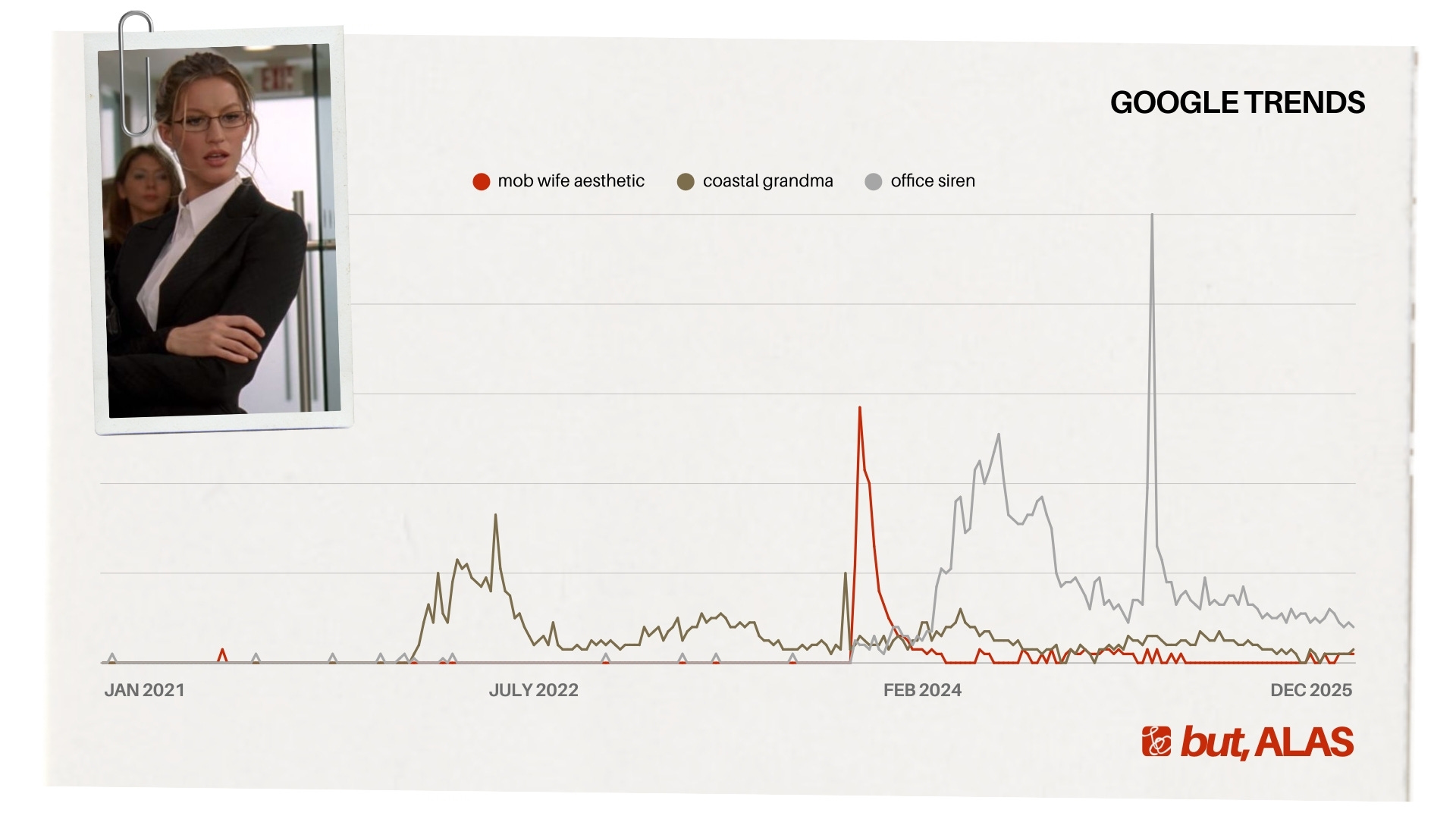
They flare.
They spike.
They collapse.
These aesthetics rely on novelty. They require energy. They assume surplus — of time, confidence, attention, margin.
They aren’t wrong. They’re just expensive.
They ask for visibility. Styling effort. Social confidence. Tolerance for interpretation.
And under sustained pressure, those are the first resources to go.
So the pattern isn’t that women stopped wanting to express themselves. It’s that daily performance stopped feeling like a safe place to do it.
The closet as an equipment locker
This brings us back to the survey. What women described wasn’t disinterest in style. It was risk management.
Getting dressed is no longer about asking:
Who do I want to be today?
It’s about asking:
What won’t cost me extra?
Extra time.
Extra attention.
Extra self-monitoring.
Extra explanation.2
That’s how clothes quietly became equipment for many women.
Things that don’t snag the day.
Don’t require adjusting.
Don’t create social debt.
When life is structured around responsibility, clothes are expected to cooperate, not inspire.
And cooperation has a look: Neutral. Repeatable. Reliable. Functional.
Not because women lack imagination — but because imagination requires slack.
Where this leaves us
If getting dressed feels flatter than it used to, that’s not personal failure.
It’s adaptive behavior.
You’re not dressing away from style.
You’re dressing toward stability.
And once you see that — once you stop moralizing it — a more dangerous question opens up:
What would it take for expression to feel safe again?
Not trendy.
Not performative.
Safe.
Up next:
Here’s where “easy” stops being neutral — and starts doing the driving.
@mom, if you’re reading this, please don’t be concerned.
if this sounds abstract, consider the scrutiny around what Rama Duwaji wore to her husband’s swearing-in ceremony — where restraint was still framed as excess.
the point isn’t the boots. it’s that with increased visibility, “correct” stops existing.
Oh my god… confidence should be expansive but instead it’s expensive. This was FASCINATING
This is so interesting! Every concept resonated with me but I haven’t put those thoughts into words. Thanks for sharing!